
1 CPU處理性能瓶頸-散熱技術(shù)
溫度過高會(huì)導(dǎo)致 CPU 損壞。熱來源→晶體管運(yùn)算,晶體管密度?,速度?
發(fā)熱:目前 intel i7-965 已超過130瓦,電子設(shè)備的失效 55%是由于過熱引起。

intel 在 其技術(shù)論壇中提及,由于線寬進(jìn)人納米尺度時(shí),其漏電流與散熱問題遲遲無法獲得一個(gè)妥善的解決方案 , 因此暫時(shí)放棄開發(fā)更高主頻率的 CPU,而轉(zhuǎn)向發(fā)展雙核心甚至多核心 CPU。 即使如此,散熱問題也只是暫時(shí)得到緩解 ,單個(gè) CPU 的發(fā)熱量仍會(huì)持續(xù)增加,散熱面臨挑戰(zhàn)更大。
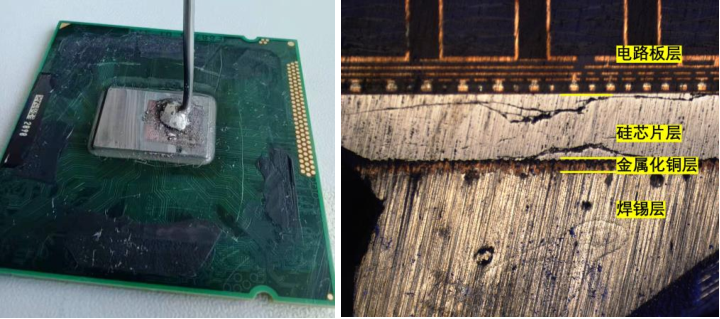
本技術(shù)可在CPU核心硅芯片表面直接低溫金屬化,焊接,優(yōu)點(diǎn)如下:
1.不損壞CPU:室溫下金屬化(20-50℃),不損壞CPU內(nèi)部電路,功能
2.導(dǎo)熱能力顯著提升:焊接導(dǎo)熱,銅熱系數(shù) (200-400Wm.k)遠(yuǎn)大于普通導(dǎo)熱硅脂導(dǎo)熱系數(shù)(1-2Wm.k),導(dǎo)熱能力顯著提升。
3.體積小,電路板=散熱片,無噪音,無灰塵,加工成本低
圖中截面可以看出,焊錫層與金屬化銅層,硅芯片層之間結(jié)合良好,芯片產(chǎn)生的熱量可以迅速傳導(dǎo)到焊錫層,顯著降低芯片工作溫度。
2 CPU處理性能瓶頸-未來趨勢(shì)
2020年9月Nature 發(fā)表一篇關(guān)于熱管理的文章,明確指出,一體化,集成化的散熱思想為未來熱管理的趨勢(shì)“Substantial research efforts have focused on improving the thermal path between the hotspot and the coolant. However, heat extraction capability is fundamentally limited by the thermal resistance between the semiconductor die and packaging”.
文章主要內(nèi)容:將發(fā)熱芯片內(nèi)部刻蝕多個(gè)微孔道,然后在其中流通冷卻液,將芯片產(chǎn)生的熱量迅速帶走,達(dá)到快速冷卻的目的,其實(shí)質(zhì)是將散熱片與發(fā)熱芯片集成在一起的冷卻結(jié)構(gòu)。


3 CPU處理性能瓶頸-結(jié)構(gòu)與應(yīng)用
如圖所示:圖a為散熱示意圖,熱量由處理器die產(chǎn)生,經(jīng)金屬層-焊接層直接傳導(dǎo)到熱沉,中間沒有低導(dǎo)熱材料,顯著提高了其導(dǎo)熱能力,圖b為CPU截面光學(xué)顯微圖片,各層接觸緊密,降低熱阻,圖c,d為CPU直接焊接到筆記本熱沉圖片,圖e為將焊接后的CPU安裝到筆記本電腦中直接運(yùn)行應(yīng)用。

4 CPU處理性能瓶頸-散熱測(cè)試
圖為魯大師溫度壓力測(cè)試結(jié)果,二者均無風(fēng)扇降溫圖a為焊接后的CPU溫度壓力測(cè)試結(jié)果,圖b為普通導(dǎo)熱硅脂升溫曲線,二者對(duì)比之下,使用本技術(shù)的CPU焊接散熱效果明顯優(yōu)于市售的導(dǎo)熱硅脂(導(dǎo)熱系數(shù)3-6W/ms), 使用本技術(shù)的筆記本經(jīng)過200s左右達(dá)到報(bào)警溫度(83℃),而相同條件下使用市售導(dǎo)熱硅脂的筆記本則用60s左右達(dá)到同樣報(bào)警溫度。
充分說明了本技術(shù)在處理散熱領(lǐng)域強(qiáng)大的應(yīng)用前景,本技術(shù)還可以應(yīng)用于手機(jī)散熱,內(nèi)存散熱,顯卡散熱,服務(wù)器散熱等處理散熱領(lǐng)域。


5 CPU處理性能瓶頸-難度挑戰(zhàn)
三個(gè)問題
?降低熱阻,高效散熱
?低溫金屬化,焊接,防止燒毀CPU
?熱失配問題
Due to imperfections in surface topography, a thermal interface material (TIM1) is typically used to reduce the contact resistance between silicon die and lid, to fill the gaps between the two imperfect surfaces. Under high magnification, even polished surfaces exhibit surface roughness sufficient for disruption of heat flow across the contacting interfaces.
Polymer based materials are commonly used as TIM1 for heat conduction across the interface. Polymer TIM comprises of conductive filler particles in a polymer matrix. Since most polymer matrix has very poor thermal conductivity, the heat conduction is mainly through the intimate contact between the filler particles,Therefore, it is easy to understand that why a 100% metal or solder TIM has much higher thermal conductivity than a polymer base TIM.

We present a welding integrated cooling structure combining heat sink and a single-crystalline silicon CPU die, produced with the need for low room temperature CPU metallization firstly and welding to the heat sink subsequently.

The layer has to absorb strain resulting from the mismatch of coefficients of thermal expansion (CTE) of the die, substrate and the integrated heat sink during temperature cycling. Figure a and b is microstructure of metallization surface , figure c is the cross-section between silicon die and metallization layer, the porous structure may release the thermal strain during temperature cycling.

6 CPU處理性能瓶頸-社會(huì)需求
在百度上查找CPU焊接散熱關(guān)鍵詞,搜索結(jié)果中很容易就能找到關(guān)于CPU直接焊接熱沉的需求,愿望,可見,這個(gè)技術(shù)已在社會(huì)中,一定程度上達(dá)成共識(shí),成為亟待解決的問題。
標(biāo)簽: 導(dǎo)熱散熱 點(diǎn)擊: 評(píng)論: